It's Never Your Fault: The Beautiful, Delusional Art of Blaming the Game
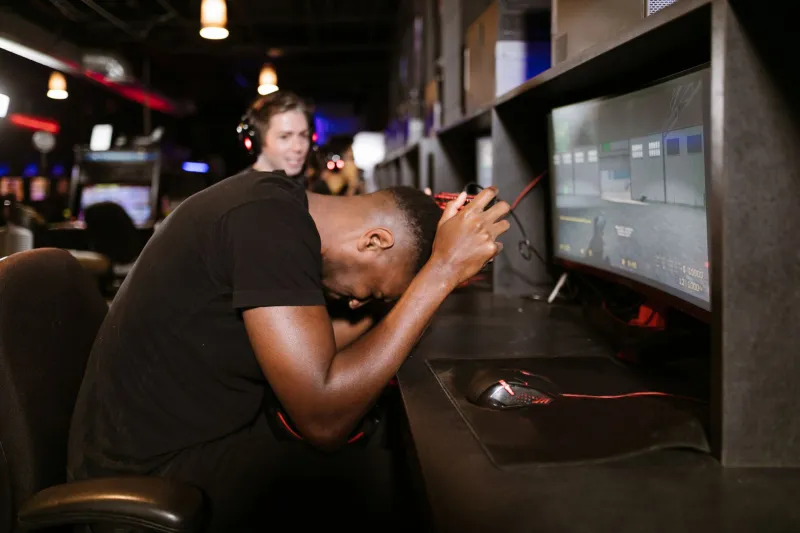
Let's paint a picture. You've died seventeen times to the same enemy. Your palms are sweating. Your snack bowl is empty. And somewhere deep in your soul, a thought crystallizes with the clarity of a thousand suns: this game is unfair. Not that you missed the dodge window by a half-second. Not that you ignored the glowing weak point for twenty minutes. No — the game did this to you. On purpose. Personally.
Welcome to the coping mechanism that built an entire culture.
The Blame Reflex: It Happens Faster Than You Think
Here's the wild part — the instinct to externalize failure in video games is basically instantaneous. Cognitive psychologists call it "self-serving bias," which is a fancy academic way of saying your brain is desperately trying to protect your ego from the knowledge that a fictional skeleton knocked you off a ledge for the eighth time. When you win, you won. When you lose, the RNG was cooked, the hitbox was broken, or the developers clearly never playtested this section.
Gaming has turbocharged this very human tendency because, unlike real life, games do sometimes have genuinely broken mechanics. That's the genius loophole. There's always a chance you're right. Maybe the netcode really is trash. Maybe that boss's attack radius is inconsistently programmed. This tiny sliver of legitimate possibility is all the ammunition a gamer needs to construct an elaborate post-game courtroom drama where they are the wronged plaintiff and the developers are guilty of crimes against fun.
The Conspiracy Theories Are Getting Out of Hand (and We Love It)
If you want to witness peak human creativity, don't go to an art museum. Go read a gaming subreddit after a new difficulty patch drops. The theories people construct to explain why they specifically are struggling are nothing short of breathtaking.
There's the classic "the hit detection is different on my copy" argument, which somehow resurfaces every few years despite games being digital downloads. There's the beloved "they nerfed this without telling anyone" claim, which occasionally turns out to be true, lending just enough credibility to keep the conspiracy alive. And then there's the crown jewel: the "the game is designed to punish skilled players" theory, in which someone has convinced themselves that their 2.3 K/D ratio in a casual shooter has made the algorithm specifically target them with bad matchmaking.
These aren't just excuses. These are lore. These are the creation myths of a thousand gaming sessions that ended in frustration and were later retold around metaphorical campfires — aka Discord servers — with increasing dramatic embellishment.
Streamers Turned "Skill Issue" Into a Weapon of Mass Comedy
At some point, the internet did what it does best: it took a defensive coping mechanism and weaponized it as a punchline. The phrase "skill issue" — delivered with maximum deadpan energy — has become one of gaming's most surgical comedy tools. Two words. Infinite damage.
Streamers figured this out fast. Nothing gets a chat moving like someone dying to an early-game tutorial enemy and immediately receiving four hundred simultaneous "skill issue" messages. The beauty of it is the total lack of mercy. It doesn't matter if you just explained a completely valid reason for the death. Chat has rendered its verdict. The judge has spoken.
But here's where it gets genuinely interesting: some streamers have flipped the script entirely, leaning into the blame-the-game bit as intentional performance. They'll die, pause, look directly into the camera, and deliver a three-minute dissertation on why the game's physics engine has a personal vendetta against them. It's theater. It's absurdist comedy. And it works because every single person watching has been there — they've had that exact internal monologue, they just didn't have a streaming platform to shout it into.
Okay But Sometimes the Game Actually Is Broken
Here's the part where we have to be honest, because King Joker operates with at least a baseline level of journalistic integrity, even when the journalism is about whether you're bad at Elden Ring.
Sometimes the excuse holds water. Genuinely. There are documented cases of games shipping with hitboxes so inaccurate they border on fiction. There are difficulty spikes so poorly designed that even the developers quietly patched them after launch without ever publicly acknowledging the problem. There are RNG systems in certain looter-shooters and card games that have been mathematically demonstrated to feel worse than true randomness because of how weighted the probabilities actually are.
So when your buddy insists that the final boss of some action RPG has an attack that's legitimately impossible to dodge on reaction time alone, there's a decent chance he's not entirely wrong. He might still be bad at the game, but he's not entirely wrong.
This is the philosophical trap at the heart of all gaming blame culture: you can never be 100% sure. The uncertainty is the point. It keeps the excuses alive.
The Spectrum of Cope: A Totally Scientific Breakdown
For research purposes, here is a completely unscientific taxonomy of gaming excuses, ranked from "actually maybe valid" to "buddy, please":
Level 1 — Plausible Grievance: "The input lag on this port is genuinely bad." (Verifiable. Sometimes true. Respect.)
Level 2 — Stretch Goal: "The enemy AI cheats at higher difficulties." (Technically games do give AI advantages, so points for effort.)
Level 3 — Committed Delusion: "My controller has drift but only during boss fights." (Sure. The drift respects narrative tension.)
Level 4 — Fully Unhinged: "The game sensed I was about to win and adjusted the RNG against me." (The game does not have feelings about you. Or does it?)
Level 5 — Ascended Being: "I'm actually so good that the game's design can't contain me, which is why I keep dying." (This person has achieved something. We're not sure what, but something.)
We're All Just Coping, and That's Completely Fine
At the end of the day, blaming the game is one of gaming's most democratic traditions. It doesn't matter if you're a casual mobile player or a veteran who speedruns FromSoftware titles — everyone has a moment where the excuse machine kicks on and starts generating reasons that have nothing to do with your own decision-making.
And you know what? That's kind of beautiful. It means you care. It means you're invested enough in the experience to be genuinely frustrated when it doesn't go your way. The elaborate conspiracy theories, the mid-session rants, the "this is objectively broken" tweets — they're all love letters to a hobby that has the audacity to challenge us and make us feel things.
So the next time you die to a boss for the twentieth time and your brain starts drafting a legal brief about unfair game design, let it cook. Enjoy the process. Blame the hitbox. Blame the RNG. Blame the developers, the publishers, and the general concept of difficulty itself.
Just maybe, quietly, in the back of your mind, try that dodge roll a little earlier next time.
Nobody has to know.