No Rank, No Suit, No Mercy: The Joker Card's Hostile Takeover of Video Games
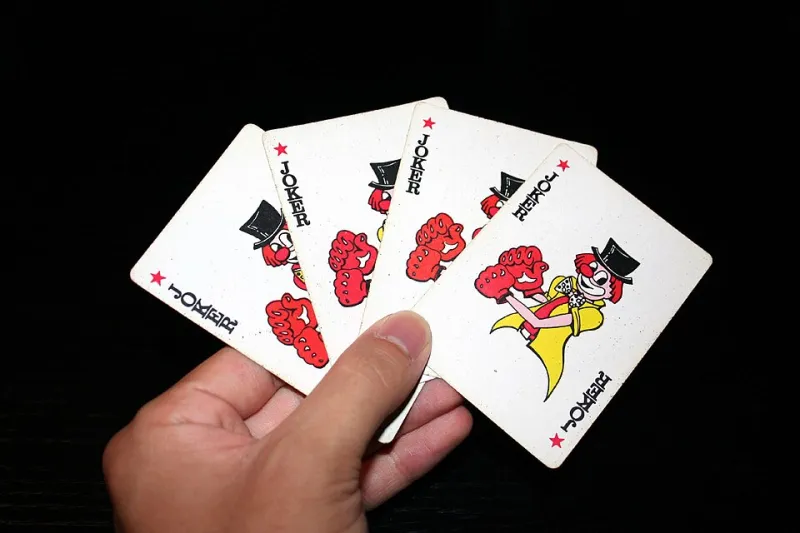
Photo: No machine-readable author provided. Enochlau assumed (based on copyright claims)., CC BY-SA 3.0, via Wikimedia Commons
Every deck of cards ships with one employee who has no job description. Fifty-two cards show up to work with a rank and a suit. The fifty-third shows up in a hat, waves at nobody in particular, and gets handed the keys to the whole game. That is the joker. It has no number, no color, and no loyalty, and yet it is the single most requested card in the building.
The joker did not earn this. The joker was invented because people could not stop fiddling with euchre.
A Card That Was Literally Invented to Break the Rules
In the 1860s, American euchre players wanted a trump card that outranked everything, because apparently a perfectly good game was not stressful enough. So printers started including a blank extra card, slapped a jester on it, and called it the best bower. That is the joker's origin story: a house rule that escaped the house and got a print run.
Think about what that means. The joker is not a card that followed the rules of cards. The joker is a card that exists because someone looked at the rules of cards and said, what if there was a guy. Every game designer who has ever added a wildcard mechanic is repeating that exact thought process, usually at 2 a.m., usually with a spreadsheet open.
The Fool Was Always the Point
The joker's cousins are everywhere once you start looking. The Fool in tarot, the court jester, the wild card in poker, the mystery box at the end of a treasure map. All of them share one feature: permission. A joker can say the thing the king cannot. A wildcard can be the card you need instead of the card you have. It is chaos, but it is chaos with a friendly face painted on it, which is somehow worse.
That is the trick. Pure randomness makes players furious. We will rage-quit a game over a bad dice roll and write a three-paragraph review about it. But randomness with a face, a personality, a stupid little grin, and we will defend it to the death. The joker is randomness in a costume. We forgive it because it looks like it is in on the joke with us.
Balatro Turned a Clown Into a Spreadsheet
You cannot talk about the joker in games without talking about Balatro, the poker roguelike that convinced millions of people to do arithmetic for a clown. The whole game is built on jokers, over a hundred and fifty of them, each one a tiny rule-breaking machine that stacks on top of the next until your score is a number science has not named yet.
The genius is not that the jokers are powerful. It is that they are illegible. You read a joker's description, you nod like you understand, and then forty minutes later you are explaining to your own reflection why the run died. Balatro made the joker the main character and then made the player the punchline. That is our entire editorial philosophy, so naturally we respect it.
Uno's Draw Four Is a War Crime With a Rulebook
Meanwhile, at the family table, the joker's loudest descendant is the wild draw four, a card that has ended more Thanksgiving dinners than politics. Uno's wild cards are the purest version of the joker promise: the rules were nice, but I have decided we are doing something else now.
Every house rule about stacking draw cards is a small act of rebellion against the printed manual. Some families stack. Some families do not. Some families have stopped speaking. All of them are playing the same game, which is not really Uno, but rather a negotiation about how much chaos the group can survive before dessert.
Why Designers Keep Reaching for It
Because a wildcard is the spot where a game admits it does not know what happens next. It is the design equivalent of shrugging, and shrugging is honest. Card battlers, board games, roguelikes, shooters with mystery pickups, hero selectors with a random option: they all want the moment where the player says oh no and then, a second later, oh YES.
And it is cheap comedy. A wildcard generates stories. Nobody tells a story about drawing a seven of clubs. People tell stories about the run where three jokers lined up and the score went sideways. Chaos is memorable because chaos has a narrative shape, and the joker is chaos you can hold in your hand.
The Only Card That Knows It Is in a Game
There is a reason the joker keeps turning up as a character name too. Persona 5's protagonist, a certain clown-themed archenemy in Gotham, half the trickster archetypes in RPGs. The joker is the only card in the deck that seems to know it is a card. That self-awareness is irresistible to writers, because it lets a character break the fourth wall without technically breaking it.
So here is the tribute. To the card with no rank. To the mechanic that exists purely so the game can surprise you and itself at the same time. To the fifty-third employee, who shows up late, ignores the dress code, and somehow gets the biggest laugh at the table every single night.
We keep dealing it out. It keeps ruining everything. We would not have it any other way.